



What Makes the AR-10 Different From the AR-15
The main difference between the AR-10 and AR-15 is scale. The AR-10 was designed around a larger 7.62×51mm cartridge, which requires a longer receiver, larger bolt carrier group, larger magazine well, and generally heavier components. The two rifles share the same basic Stoner design language, but modern large-frame ARs are also less standardized than the AR-15, making parts compatibility more complicated.
The AR-10 vs AR-15 comparison is often reduced to caliber: the AR-10 fires .308-class ammunition while the AR-15 is associated with 5.56 NATO. That is the easiest difference to see, but it is not the most useful way to understand the two platforms. The larger cartridge changes the physical scale of the action, firearm parts and accessories, which affects the receiver, magazine, bolt carrier group, recoil system, weight, and overall handling of the rifle. Just as important, the modern large-frame AR market never developed the same level of parts standardization that makes the AR-15 ecosystem so predictable.
They look closely related because they are. They are not, however, the same rifle with different barrels.
The AR-10 Actually Came First
The relationship between the two rifles makes more sense once the timeline is reversed. Eugene Stoner developed the original AR-10 around the 7.62×51mm NATO cartridge in the 1950s. The smaller AR-15 followed when the basic concept was scaled down around the lighter 5.56×45mm cartridge.
That lineage is why the two rifles share so much visually and mechanically. However, the smaller rifle eventually became far more widespread. Military adoption of the AR-15/M16 family created a huge manufacturing base, and the civilian market later expanded around the same general architecture. That history helps explain why today’s AR-15 platform has a much more unified aftermarket than its larger predecessor.
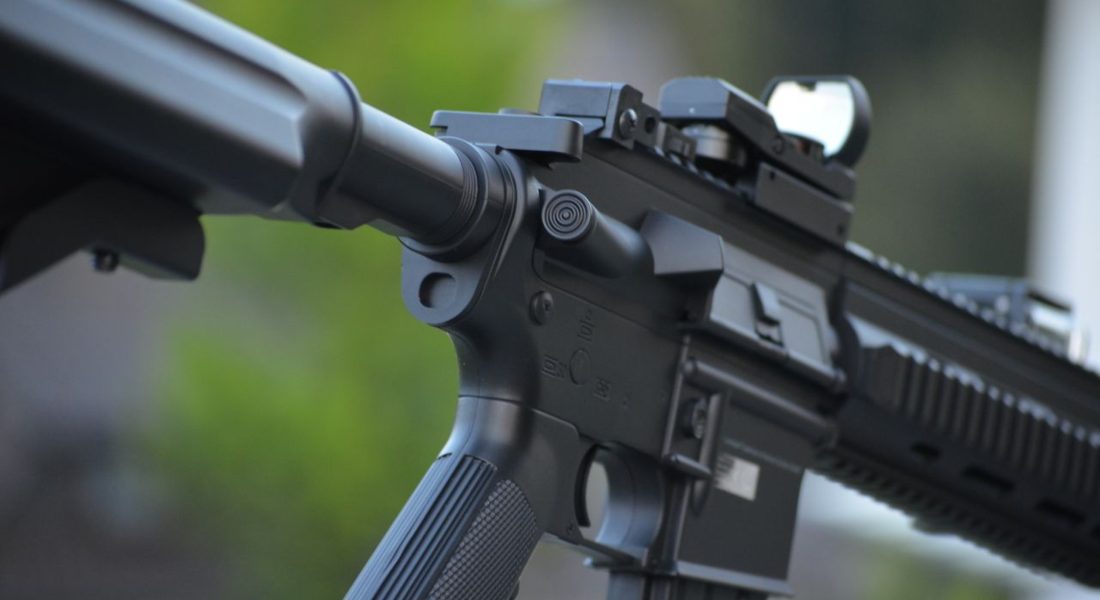
Cartridge Size Changes the Whole Platform
The most fundamental mechanical difference is the size of the ammunition each platform was designed around. The original AR-10 used 7.62×51mm NATO, while the AR-15 was scaled around the smaller 5.56×45mm cartridge.
Modern versions of both platforms can be chambered in other calibers, so “AR-10 equals .308” and “AR-15 equals 5.56” are useful shorthand rather than absolute rules. The more important distinction is cartridge class. Large-frame ARs are built around longer cartridges that require more room inside the action.
That extra length affects the rifle from the magazine forward. A larger cartridge needs a larger magazine, a longer magazine well, a longer receiver set, and a bolt and carrier sized to handle the larger case head and operating forces.
Where the Extra Size Shows Up
The AR-10 and AR-15 share the same general layout, but their major components are sized around different ammunition envelopes.
| Feature | AR-15 | AR-10 / Large-Frame AR |
|---|---|---|
| Typical cartridge class | 5.56 / .223-size | .308 / 7.62-size |
| Receiver | Shorter small-frame receiver | Longer large-frame receiver |
| Magazine well | Sized for shorter cartridges | Longer and larger |
| Bolt carrier group | Smaller and lighter | Larger and heavier |
| Typical rifle weight | Generally lighter | Generally heavier |
The table describes the broad platform difference rather than a universal specification. Large-frame AR dimensions can vary between manufacturers, which becomes important once compatibility enters the discussion.
The Operating System Is More Similar Than It Looks
Scaling the rifle up does not change the basic design language. Both platforms divide their major functions between an upper and lower receiver:
- The upper still contains the barrel, bolt carrier group, and gas system responsible for chambering, locking, firing, extraction, and cycling.
- The lower still carries the fire-control components, magazine interface, selector, and recoil-system connection.
They also both use a rotating multi-lug bolt, place the recoil system in line with the action, and retain familiar controls and overall ergonomics.
That similarity is why an AR-10 feels immediately familiar to someone accustomed to an AR-15. Charging, magazine changes, selector use, stock placement, and general handling follow the same basic logic even though the components doing the work are larger. It is also where a common assumption begins: if the architecture is so similar, the parts must interchange. That is where the comparison gets more complicated.
The Biggest Compatibility Difference Is Standardization
The AR-15 benefited from decades of military production built around common dimensions. Multiple manufacturers had to produce rifles and replacement components that could work within the same established system, and the civilian aftermarket inherited much of that emphasis on interchangeability.
That history is why mil-spec AR-15 dimensions still matter. A trigger, selector, pin set, or other component can be produced by one company while the receiver comes from another because manufacturers generally know which dimensional assumptions the market expects.
That predictability is also why there are so many AR-15 platform components, such as super safety cams and super safety levers. Products can be designed around documented AR-15 geometry without every item needing to be reinvented for a completely different receiver family.
Why “AR-10 Compatible” Needs More Context
The large-frame market does not work quite the same way. “AR-10” is often used casually to describe almost any .308-size AR-pattern rifle, but not every large-frame AR follows the same dimensions or even the same receiver pattern.
ArmaLite itself has produced AR-10A and AR-10B families with differences in magazines, upper and lower receivers, bolt stops, and magazine catches. Other manufacturers have built around DPMS LR-308, SR-25-derived, or proprietary patterns. Parts that look almost identical can therefore differ in receiver geometry, barrel-nut threads, handguard dimensions, bolt-carrier sizing, magazine compatibility, or recoil-system requirements.
That does not mean every part is unique. Some small controls and fire-control components may share AR-15-style dimensions on particular large-frame rifles. It does mean that visual similarity is not enough to establish compatibility. An AR-15 FCG kit, for example, is sold around AR-15 fitment requirements; its existence should not be treated as evidence that every large-frame receiver uses the same fire-control geometry. The manufacturer and exact platform pattern still determine fit.

Size Changes How the Two Platforms Behave
The larger action and ammunition also affect how the rifles behave in use. Large-frame ARs are generally heavier because the receiver set, barrel, bolt carrier group, and other components must accommodate the larger cartridge. The ammunition itself also adds weight.
That extra mass is paired with a more powerful cartridge class and a different recoil impulse. The AR-15’s smaller action and lighter ammunition generally produce a lighter rifle with less recoil, while the large-frame platform gives shooters access to full-power rifle cartridges that require more material and operating mass.
Magazine capacity often reflects the same tradeoff. A 30-round magazine is common on a 5.56 AR-15, while 20-round magazines are typical on .308-size platforms because each cartridge occupies considerably more space.
These differences are consequences of scale rather than completely different design philosophies. The AR-10 does not become heavier because manufacturers simply choose to make it heavier; the platform is built around ammunition that demands more room and more substantial components.
Why the AR-10 and AR-15 Aren’t Interchangeable
The AR-10 and AR-15 share the same basic design lineage, but the larger cartridge class changes the dimensions of the action and many of the components around it. Receivers, magazines, bolt carrier groups, barrels, and other major parts are therefore sized differently.
The compatibility gap becomes even wider in the modern market. The AR-15 developed around much more standardized dimensions, while large-frame ARs still include several competing patterns. Two rifles can look closely related and operate in familiar ways without accepting the same parts. The AR-10 and AR-15 are part of the same design family, but scale and standardization make them different platforms.
FAQs
What is the main difference between an AR-10 and AR-15?
The main difference is platform scale. The AR-10 was designed around larger 7.62×51mm-class ammunition, while the AR-15 was scaled around the smaller 5.56×45mm cartridge. That changes receiver length, magazine size, bolt-carrier dimensions, weight, and other major components.
Did the AR-10 or AR-15 come first?
The AR-10 came first. Eugene Stoner developed the original 7.62mm AR-10 in the 1950s, and its basic architecture was later scaled down around 5.56mm ammunition to create the AR-15.
Are AR-10 and AR-15 parts interchangeable?
Most major parts are not interchangeable. Large-frame ARs use different receivers, magazines, bolt carrier groups, barrels, and other platform-specific components. Some smaller controls or fire-control parts may share dimensions on certain rifles, but compatibility should always be verified for the exact manufacturer and pattern.
Is every .308 AR an AR-10?
No. “AR-10” is commonly used as shorthand for large-frame AR-pattern rifles, but the original AR-10 is an ArmaLite design. Other .308-size rifles may follow DPMS LR-308, SR-25-derived, or manufacturer-specific patterns with different component dimensions.
Why are AR-10 parts less standardized than AR-15 parts?
The AR-15 benefited from decades of military standardization and a commercial aftermarket built around widely accepted dimensions. Large-frame ARs developed through several competing patterns instead, so receiver geometry, magazines, handguards, bolt carrier groups, and other components can vary between manufacturers.