



Cold Bore vs Hot Bore: Why POI Shift Isn’t Always the Barrel
A POI shift as your rifle heats up has at least four possible sources: the barrel, the round sitting in a hot chamber, handguard or rail contact, and mirage in front of the optic. In Recoil's AR-15 testing, a government-profile barrel moved 2 inches low and 1 inch left after a 30-round dump, while a medium profile moved 0.5 inch. Ammunition heat matters too: Sierra measured a .308 load 96 fps faster at 130.5°F than at 70°F. Isolate each source before you replace the barrel.
Your first group lands right where you zeroed. Twenty rounds later, the next group sits low and left, and the barrel takes the blame. Sometimes that’s fair. Often it isn’t. Heat doesn’t stay in the barrel. It moves into the chamber, the handguard, the rail, and the air in front of your optic, and each one can produce a POI shift that looks the same on paper. Redacted Arms designs and builds firearm parts and accessories in Pennsylvania, so we’d rather you replace the right part than the most expensive one. Here’s how to find which part of the rifle is actually moving your point of impact.
What do cold bore, warm bore, and hot bore actually mean?
A cold bore is a barrel at ambient temperature that hasn’t fired that session yet. A warm bore has a few rounds through it. That’s enough to leave fouling and take the chill off the steel, but not enough to heat it. A hot bore has taken a sustained string, the kind that changes group size and position.
The first shot from a cold bore often lands apart from the rest, and heat is rarely the reason. Three things change between shot one and shot two. The bore is no longer clean, any oil left inside has burned out, and the steel has started to warm. If you clean your firearms right before a range trip, expect the first shot or two through the clean bore to print differently. That’s a cold bore shift, not a heat problem. It settles once the bore carries fouling again.
Where heat-related shift comes from
| Heat source | What you see on target | When it shows up | Quick isolation check |
|---|---|---|---|
| Barrel | Groups open and walk in one consistent direction | During and after fast strings; thin and fluted profiles first | Cool fully, then shoot a slow 5-shot group |
| Chambered round | Vertical stringing, impacts climbing | A round sits in a hot chamber before firing | Chamber only when ready to fire, then compare |
| Handguard or rail contact | Shift that changes with bipod, sling, or rest position | A loaded handguard meets a hot barrel | Shoot hot from one rest, then move the support point |
| Optic mount across the handguard joint | Zero moves as the handguard heats or flexes | The mount spans the receiver and handguard | Confirm the mount sits on one continuous rail section |
| Mirage | Target image wavers or looks offset | Hot barrel or suppressor on calm, sunny days | Watch the image between shots; add a mirage band |
How heat migrates through the rifle
The barrel is the heat source, but it’s not the only part that gets hot. In Shooting Illustrated’s 2025 barrel test, every barrel ran hotter at the muzzle than at the chamber. One medium-heavy steel barrel reached 126.3°F at the muzzle after a 15-shot string. That heat moves outward: into the round waiting in the chamber, into the barrel nut and handguard, and into the air above the barrel.
The chambered round heat-soaks
A round sitting in a hot chamber doesn’t stay at ambient temperature. A shooter waiting on target scoring can leave a round chambered anywhere from a few seconds to almost a minute. The powder warms, and velocity climbs with it. Sierra’s .308 test shows the scale: 2,500 fps at 70°F and 2,596 fps at 130.5°F. Faster rounds print higher, so the result is a vertical POI shift, not a barrel walking sideways.
Powder temperature sensitivity makes ammunition choice part of the heat diagnosis. One Handloader test measured a typical powder gaining 1.9 fps per degree. In PrecisionRifleBlog’s testing, Varget and H4350 gained about 0.14 fps per degree. That gap matters at distance, since a 14 fps swing is worth about 3.75 inches of elevation at 1,000 yards.
The handguard and rail carry heat forward
On a bolt gun, a hot barrel can press against the stock and walk shots up the target. On an AR, the handguard plays that role. A free-float handguard only stays free-float if the barrel never touches it. A bipod, sling, or hard rest loads the handguard toward the barrel, and drop-in handguards press on the barrel by design.
Barrel-to-handguard clearance is one of the firearm tolerances that rarely matters cold and starts to matter hot. A gap that’s barely there at the bench leaves no margin once the handguard is loaded and flexing.
The optic sees mirage before the bullet moves
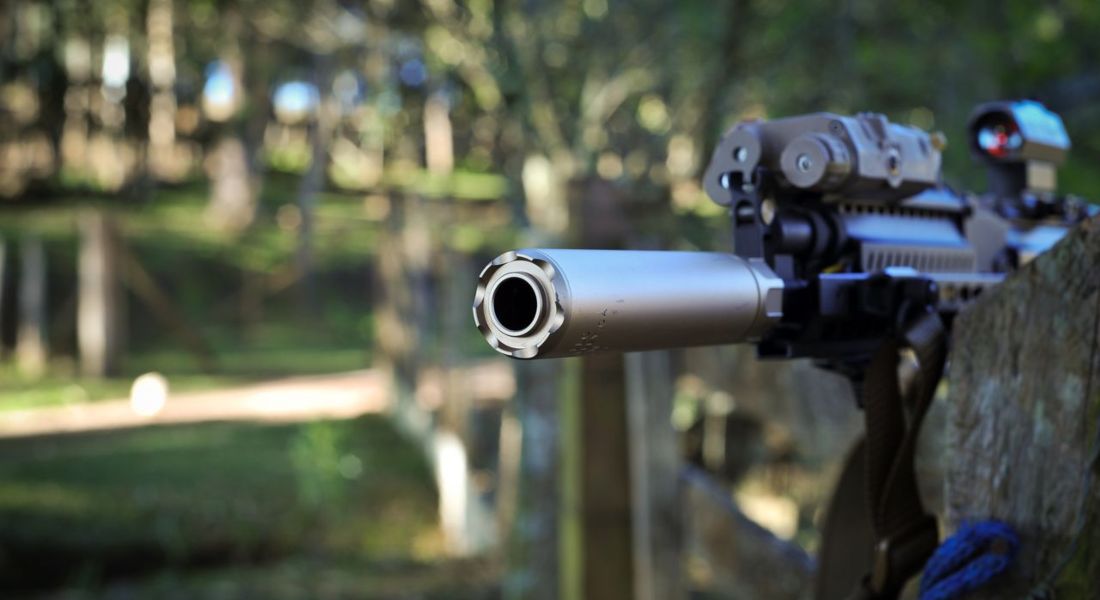
Mirage is the one heat source that moves the image, not the bullet. Heat rising off the barrel bends light between the objective lens and the target. The reticle sits on a target that isn’t quite where it looks, and shots go where the rifle points. Suppressed rifles make it worse, since the can holds heat right in the line of sight.
The optic mount can also inherit handguard movement. A mount that spans the joint between the upper receiver and the handguard rides two separate parts. If the handguard shifts, flexes, or heats unevenly, the optic goes with it.
When is POI shift actually a barrel problem?
Sometimes it is the barrel, and profile matters most. In Recoil’s AR-15 test, each barrel fired a 5-shot group, took a 30-round dump, then fired a second group. The government profile grew from 1.332 MOA to 2.55 MOA and moved 2 inches low and 1 inch left. The medium profile grew from 0.966 MOA to 1.055 MOA and moved only 0.5 inches right. The pencil profile showed the biggest temperature rise at the barrel nut and throat, at 25°F.
A barrel-driven shift has a clear signature. It moves in one consistent direction as heat builds, the group grows as it goes, and both return once the barrel cools. Thin and fluted barrels show it first. In Shooting Illustrated’s test, the fluted steel barrel heated fastest and cooled more slowly than expected.
How do you tell which one you’re dealing with?
Run one session in this order, from the same rest, with the same ammunition:
- Start cold and fire a slow 5-shot group as your baseline.
- Fire a fast 20- to 30-round string, then a second 5-shot group, chambering each round only when ready to fire.
- Fire a third group, leaving each round in the chamber for 30 to 60 seconds first. A vertical climb against group two points to ammo heat soak.
- Move the bipod or sling and fire again. A shift that follows the support point is handguard contact.
- Let the rifle cool to ambient and fire a final group. If point of impact returns, the cause was heat.
A POI shift that doesn’t return after cooling usually isn’t heat at all. An under-torqued barrel nut or a handguard installed off-axis is one of the AR-15 assembly mistakes that shows up as a zero that won’t stay put.
If your rifle’s job is a first-shot hit, set the zero from a cold bore. American Hunter’s cold-bore zero method uses four or five rounds, each fired after the barrel cools. The same piece notes that ammunition can shift as much as 6 inches at 100 yards between January and July.
Rule out the shooter before the hardware
A long string tires the shooter as fast as it heats the barrel. Grip pressure changes, the trigger press gets rushed, and follow-up shots drift. That spread can look exactly like heat. End the session with one slow, deliberate group from a fully cooled rifle. If it’s still loose, the variable is the shooter, not the steel.
Trigger reset consistency is part of that picture. On a rimfire pistol, the TX22 ART uses the slide’s cycling motion to push the trigger forward on reset, so every follow-up starts from the same point. The same principle applies to a rifle trigger: a consistent reset removes one more variable before you start replacing parts.
Find the cause before you replace the barrel
Heat moves through the whole rifle: the chamber, the handguard, the rail, and the air above the barrel. The barrel only earns the blame when the shift grows with heat, holds one direction, and disappears once the rifle cools. Run the isolation test, fix what it points to, and then decide whether the barrel needs replacing.
Redacted Arms builds parts around the same idea: remove variables until the rifle is consistent. If trigger consistency made your list, the AR-15 super safety uses an active reset, so the trigger returns the same way every shot. One fewer variable makes any POI shift easier to read.
References
AccurateShooter. (2023, June). How ammo temperature affects velocity, pressure, and POI. Daily Bulletin. https://bulletin.accurateshooter.com/2023/06/how-ammo-temperature-affects-velocity-pressure-and-poi/
Recoil Magazine. (n.d.). AR-15 barrel profile testing: Heat, size, & why it matters. https://www.recoilweb.com/ar-15-barrel-profile-testing-187254.html
Sadowski, R. (2025, March 16). Heat and rifle barrels. Shooting Illustrated. https://www.shootingillustrated.com/content/heat-and-rifle-barrels/
Zant, C. (2025, March 8). Powder temperature sensitivity: The hidden factor affecting your long-range accuracy. PrecisionRifleBlog. https://precisionrifleblog.com/2025/03/08/powder-temperature-sensitivity/
FAQs
What is a cold bore shot?
A cold bore shot is the first shot from a barrel at ambient temperature that hasn't been fired that session. It often lands apart from later shots because the bore is clean, may still carry oil, and the steel hasn't warmed yet.
Why does my POI shift when the barrel gets hot?
Heat changes how the barrel behaves, especially thin and fluted profiles. It also spreads into the chambered round, the handguard, and the air above the barrel. Any of those can move point of impact, so the barrel isn't always the cause.
How much does POI change from cold bore to hot bore?
It depends mostly on barrel profile. In Recoil's AR-15 test, a government-profile barrel moved 2 inches low and 1 inch left after a 30-round string, while a medium profile moved 0.5 inch.
Does a free-floated barrel stop POI shift?
A free-float handguard removes handguard pressure on the barrel, but only while nothing touches it. It doesn't stop barrel heat, ammunition heat soak, or mirage.
Should I zero with a cold or warm barrel?
Zero for how you'll shoot. For a hunting or defensive rifle where the first shot matters most, zero from a cold bore. For a rifle that shoots strings, confirm zero with a warm barrel as well.
Does ammo temperature affect point of impact?
Yes. Sierra measured a .308 load at 2,451 fps at 25.5°F, 2,500 fps at 70°F, and 2,596 fps at 130.5°F. Hotter ammunition shoots faster and prints higher, and temperature-stable powders shrink that effect.